Hypokalemia nursing interventions
Nursing interventions for hypokalemia (potassium under 3.5 mEq/L) are to replace potassium safely and find the cause. Give oral potassium with food, and give IV potassium only diluted on a pump, never by IV push. Monitor the ECG for changes, watch for muscle weakness and cramps, and remember low potassium raises the risk of digoxin toxicity.
What hypokalemia is, and why the NCLEX tests it
Normal potassium is 3.5 to 5.0 mEq/L. Loop and thiazide diuretics, insulin, and steroids all lower it, and IV potassium replacement is one of the exam's top safety items, so hypokalemia interventions appear often.
Key nursing considerations for hypokalemia
IV potassium is never given by push or bolus; it can cause fatal cardiac arrest. Always dilute and infuse slowly on a pump.
Give oral potassium with food and a full glass of water or juice to reduce GI upset.
Potassium is excreted by the kidneys, so confirm adequate urine output before giving it.
Watch for ECG changes, muscle weakness, cramps, and an irregular pulse.
Low potassium worsens digoxin toxicity, so a patient on both needs close monitoring.
How the NCLEX turns hypokalemia into a question
Report muscle weakness or cramps, an irregular pulse, and any burning at an IV potassium site.
Priority never IV push potassium; dilute it and infuse slowly on a pump after confirming urine output, and monitor the ECG.
Lab potassium (normal 3.5 to 5.0 mEq/L), kidney function, and the ECG.
Teach for maintenance, eat potassium-rich foods such as bananas, oranges, and potatoes if the provider advises, and take oral potassium with food.
An order to IV push 10 mEq of potassium chloride. Recognize that this is never done; it must be diluted and infused slowly on a pump.
Quick answers
What is the safe way to give IV potassium?
Always diluted and infused slowly on an infusion pump, never by IV push or bolus, which can cause fatal cardiac arrest. Confirm urine output first.
What are the signs of hypokalemia?
Muscle weakness and cramps, fatigue, and an irregular pulse, with characteristic ECG changes. Potassium under 3.5 mEq/L is low.
Why is hypokalemia dangerous with digoxin?
Low potassium worsens digoxin toxicity even when the digoxin level is normal, so patients on both need careful monitoring.
Keep studying
These pages build on each other. Work through the related classes, then pressure-test yourself against the free cheat sheet and the full guide.
Digoxin level targets
0.8 to 2 ng/mL, and the potassium trap.
Read the guide →Digoxin patient teaching
Pulse-taking, toxicity signs, never double up.
Read the guide →ACE inhibitor cough
Bradykinin cough, and switching to an ARB.
Read the guide →Acetaminophen antidote
Acetylcysteine, the 4 gram cap, hidden sources.
Read the guide →All high-yield drug classes
The seven most-tested classes on one page, each decoded the same way.
Open the overview →Antidotes & lab values cheat sheet
The must-know antidotes, drug levels, and lab cutoffs, free and printable.
Open the cheat sheet →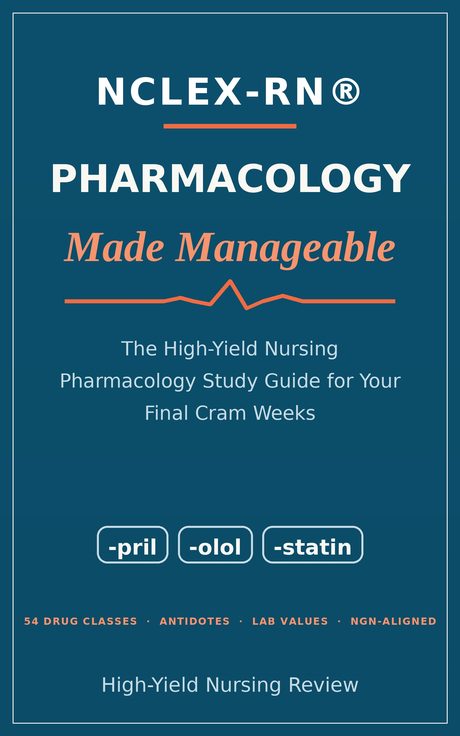
Every high-yield class, decoded the same way
You just read the hypokalemia breakdown. The full guide runs all 54 high-yield drug classes on one repeatable system, then closes with the cram tables: antidotes, therapeutic drug levels, must-know lab values, the suffix sheet, and a final-week checklist.
98-page PDF + EPUB · instant download · 7-day money-back guarantee · free sample
Get the high-yield cheat sheet by email
Drop your email and we will send you the free High-Yield NCLEX Pharmacology Cheat Sheet as a printable PDF right away: antidotes, high-alert drugs, and the lab-value cutoffs the exam leans on. We email rarely, and you can unsubscribe in one click. Founding reviewers welcome: after you join, just reply to the welcome email and we will send you the full guide free to review honestly.