See the difference before you buy
Fair question for a $12.99 guide from a name you have not heard of: what makes it different from every other pharm review? This. Below are three complete class pages, Insulin, Heparin, and Warfarin, with the one thing no other guide packages pulled to the top of each: the decoder box that predicts how the NCLEX will ask that class, plus a worked example. Read them and decide for yourself.
A genuine, unedited preview built from the same manuscript as the finished guide, so what you see is what you get. It is not a marketing summary. The decoder box that leads each chapter is the one asset no other pharm product packages, and it is why studying this converts into recognizing the question. The clinical facts here were cross-checked against standard nursing pharmacology references before release. This is a study aid for the exam, not medical advice.
The complete table of contents
The full guide is 98 pages: 54 high-yield drug classes across nine body systems, all on the same five-part system, plus the back-matter cram tables. Here is every chapter.
Getting Started
- How to Use This Book (the 5-part system)
- The 30-Second Orientation to NCLEX Pharmacology
- How the NCLEX Tests Medications (the 4 recurring angles + NGN)
- The Universal Safety Rules (worth 10 memorized drug facts)
- High-Alert & Black-Box Drugs at a Glance
Part 1 — Cardiovascular Medications
- Cardiac Glycosides (Digoxin)
- Antianginals — Nitrates
- Beta-Blockers
- ACE Inhibitors
- Angiotensin II Receptor Blockers (ARBs)
- Calcium Channel Blockers
- Diuretics (Loop, Thiazide, Potassium-Sparing, Osmotic)
- Antidysrhythmics (Amiodarone & the class overview)
- Antihyperlipidemics (Statins & others)
- Antihypertensive add-ons (Central alpha-2 agonists, Alpha-1 blockers)
Part 2 — Blood: Anticoagulants, Antiplatelets & Thrombolytics
- Heparin (Unfractionated) & Low-Molecular-Weight Heparin
- Warfarin
- Direct Oral Anticoagulants (DOACs)
- Antiplatelets (Aspirin, Clopidogrel)
- Thrombolytics ("Clot-busters")
Part 3 — Endocrine Medications
- Insulins
- Oral & Non-Insulin Antidiabetics
- Thyroid & Antithyroid Drugs
- Corticosteroids
Part 4 — Respiratory Medications
- Short-Acting Beta-2 Agonists (Rescue) & LABAs
- Inhaled Anticholinergics
- Inhaled Corticosteroids & Leukotriene Modifiers
- Methylxanthines (Theophylline)
Part 5 — Anti-Infective Medications
- Penicillins
- Cephalosporins
- Macrolides
- Tetracyclines
- Aminoglycosides
- Fluoroquinolones
- Sulfonamides
- Vancomycin
- Antitubercular Drugs
Part 6 — Neurologic & Psychiatric Medications
- Anticonvulsants (Antiepileptics)
- Benzodiazepines & the Sedative-Hypnotics
- Opioid Analgesics & Reversal Agents
- Antidepressants (SSRIs, SNRIs, TCAs, MAOIs)
- Lithium & Mood Stabilizers
- Antipsychotics (Typical & Atypical)
Part 7 — Gastrointestinal, Pain & Other High-Yield Classes
- Proton Pump Inhibitors & H2 Blockers
- Antacids & Mucosal Protectants
- Antiemetics
- Non-Opioid Analgesics — Acetaminophen & NSAIDs
Part 8 — Additional High-Yield Classes
- Antivirals & Antifungals
- Bone Health — Bisphosphonates
- Gout Medications
- Antidiarrheals & Laxatives
- Antihistamines
- Parkinson's & Alzheimer's Medications
- Chemotherapy — Safety Principles
Part 9 — Parenteral Therapies & Safe Medication Administration
- The Rights & High-Alert Safeguards
- IV Fluids, Electrolytes & IV Potassium Safety
- Blood & Blood Products
- Total Parenteral Nutrition (TPN) & Central Lines
- Dosage Calculation Essentials
Back Matter — The Cram Tables
- Master Antidote / Reversal-Agent Table
- Therapeutic Drug-Level Table
- Must-Know Lab Values Table
- High-Alert & Black-Box Quick List
- The "Suffix = Drug Class" Cheat Sheet
- Final-Week Cram Checklist
- References & Clinical-Accuracy Note
How to Use This Book — The 5-Part System
You do not have time to learn everything about every drug, and the NCLEX does not ask you to. It asks a narrow, predictable set of things. This book is built around that fact.
Pharmacology feels like a "blurry mess" when you try to memorize hundreds of individual drugs. The fix is to stop memorizing drugs and start memorizing classes. Almost every drug on the NCLEX belongs to a class, and the class shares a mechanism, a signature set of side effects, and a teaching point. Learn the class once, and you can answer a question about any drug in it — even one you've never seen — by recognizing the suffix (the -pril, the -olol, the -statin).
Every chapter in this book gives you the same five things for a class, and nothing else — because these five are what the exam rewards:
(a) The mechanism that matters — one line. Not the biochemistry lecture; the single idea that explains the side effects and the nursing care.
(b) Side effects & safety monitoring — the 2–3 the NCLEX actually asks about, including the one you must report and the lab or vital sign you must check.
(c) The classic patient-teaching point — the sentence the "correct answer" nurse says to the patient.
(d) A memory hook — a mnemonic or image so it sticks in the cram window.
(e) How the NCLEX tests this class — the specific question angles used for this class, so you recognize the trap before you read the options.
Read a chapter, cover the page, and say the five parts out loud. If you can, you own that class. That is the whole method.
Suggested cram-window plan (adapt to your time):
- If you have 3–5 weeks: one Part per few days; re-read the "How the NCLEX tests this class" box for every chapter twice.
- If you have 1 week: read the Universal Safety Rules, the High-Alert list, and the back-matter Cram Tables first — they carry the most points per minute — then read each chapter's five-part box and skip the prose.
- If you have 48 hours: read only the five-part boxes and the back-matter tables. Prioritize insulin, anticoagulants, digoxin, opioids, and the antidote table.
16. Insulins
Key drugs by action (onset / peak / duration — memorize the peaks):
| Type | Examples | Onset | Peak | Duration | Notes |
|---|---|---|---|---|---|
| Rapid-acting | lispro, aspart, glulisine | ~15 min | ~1–2 h | 3–4 h | Give with the meal (0–15 min before) |
| Short-acting (Regular) | regular (Humulin R / Novolin R) | 30–60 min | ~2–3 h | 5–8 h | Only insulin given IV; give ~30 min before meal |
| Intermediate | NPH | 1–2 h | ~4–12 h | 12–18 h | Cloudy; suspension |
| Long-acting | glargine, detemir, degludec | 1–2 h | No pronounced peak | ~24 h | Do not mix with other insulins |
Read this box first. It is the part no other guide packages: the exact angles the NCLEX uses for this class. The mechanism, side effects, teaching, and memory hook that make it stick follow right underneath.
- Side-effect to report / recognize: hypoglycemia (know the signs and the Rule of 15).
- Priority nursing action: if hypoglycemic and conscious, give 15 g fast carbs and recheck; anticipate the peak time ("when should the nurse watch most closely for a reaction?").
- Patient teaching: site rotation, storage, mixing order, sick-day rules, recognizing lows.
- Lab/vital to check: blood glucose (and potassium in specific scenarios).
- 🧩 NGN cue: a patient given rapid insulin whose breakfast tray is delayed = high hypoglycemia risk; the correct action is to hold or obtain food, not "give more insulin."
⚠️ The traps the NCLEX plants for insulin — and how to beat them
- "Give more insulin because the sugar is low or the tray is late." Trap: at the peak, a delayed meal means hypoglycemia risk, so more insulin makes it worse. Beat it: get fast carbs or the meal and recheck; treat a low by the Rule of 15.
- "Draw up the cloudy NPH before the clear Regular." Trap. Beat it: clear before cloudy ("RN = Regular before NPH") so you never contaminate the clear vial.
- "Any insulin can be given IV." Trap. Beat it: only Regular (short-acting) insulin is given IV.
Question forms to expect for this class: timing/peak reasoning ("when to watch for a reaction"), mixing-order and storage teaching, and the "hold food vs. give insulin" priority.
Which statement by a client mixing NPH and Regular insulin needs correction?
- A. "I draw up the clear Regular insulin before the cloudy NPH."
- B. "I roll the NPH gently instead of shaking it."
- C. "I keep the vial I'm using at room temperature and spares in the fridge."
- D. "I shake the bottle hard and keep my spare vials in the freezer."
Answer: D. Insulin is rolled, never shaken, and is never frozen; A, B, and C are correct and therefore the distractors.
At 0730 a client receives NPH insulin subcutaneously. The nurse should watch most closely for hypoglycemia during which time frame?
- A. 0730 to 0800 (right after the injection).
- B. Late morning through early evening (about 4–12 hours after the dose).
- C. Only at bedtime.
- D. NPH does not cause hypoglycemia as long as the client eats.
Answer: B. Hypoglycemia is most likely at the insulin's peak, and NPH peaks about 4–12 hours after the dose, so late morning to evening is the highest-risk window. Predicting the peak is the "when should the nurse watch most closely" angle. One more, faster: a client given lispro (rapid-acting) insulin whose breakfast tray is delayed 40 minutes needs a fast carbohydrate or the meal now and monitoring, not more insulin, because rapid insulin peaks in about 1–2 hours and is timed to the meal.
The class, decoded
(a) Mechanism that matters: Insulin moves glucose out of the blood and into cells (and drives potassium into cells too, which is why IV insulin plus dextrose treats hyperkalemia). It is essential in type 1 and used in type 2 diabetes.
(b) Side effects & safety monitoring:
- Hypoglycemia is the emergency: shakiness, sweating, tachycardia, hunger, confusion, progressing to seizures/coma. Most likely at the insulin's PEAK. Treat conscious patients by the Rule of 15: give 15 g of fast-acting carbohydrate (4 oz juice, glucose tablets), recheck in 15 minutes, repeat if still low. Unconscious or NPO patients get IV dextrose or glucagon.
- Hypokalemia (insulin shifts potassium into cells).
- Lipohypertrophy at injection sites, so rotate sites within one region.
- High-alert drug: unit errors and look-alike names (Humalog vs. Humulin) cause serious harm.
(c) Classic patient teaching: "Rotate your injection sites within one body area. Store the vial or pen you are using at room temperature and keep spares in the refrigerator, and never freeze insulin. Roll (do not shake) cloudy NPH to mix it. Learn the signs of a low blood sugar and always carry a fast sugar source. Do not skip meals after taking insulin."
Mixing rule (NPH + Regular): draw up the clear (Regular) before the cloudy (NPH), remembered as "clear before cloudy" and "RN = Regular before NPH."
(d) Memory hook: "When it PEAKS, watch for the LOW." "Clear before cloudy." Rapid insulin is "with the plate" (give when the food arrives).
11. Heparin (Unfractionated) & Low-Molecular-Weight Heparin
Key drugs: unfractionated heparin (UFH, IV/subcutaneous); low-molecular-weight heparin (LMWH), that is enoxaparin (Lovenox), dalteparin.
Read this box first. It is the part no other guide packages: the exact angles the NCLEX uses for this class. The mechanism, side effects, teaching, and memory hook that make it stick follow right underneath.
- Side-effect to report: any bleeding; a falling platelet count (HIT).
- Priority nursing action: monitor aPTT (UFH) and platelets; for overdose or bleeding, anticipate protamine sulfate; give subcutaneous injections correctly (do not aspirate, do not rub).
- Patient teaching: injection technique, bleeding precautions.
- Lab/vital to check: aPTT (UFH), platelet count, hemoglobin/hematocrit.
- 🧩 NGN cue: platelet count dropping from 250,000 to 90,000 several days into heparin = suspect HIT, so stop heparin and notify.
A client on a continuous IV heparin infusion has an aPTT of 92 seconds (control 30 s; therapeutic about 46–70 s) and a platelet count that has fallen from 240,000 to 88,000/mm³ over three days. Which actions are appropriate? Select all that apply.
- ✓ Prepare to stop the heparin infusion.
- ✓ Notify the provider.
- ✓ Ensure protamine sulfate is available.
- × Increase the infusion rate to push the aPTT higher.
- × Administer vitamin K.
Answer: stop the heparin, notify the provider, and have protamine sulfate available. The aPTT is far above 1.5 to 2.5 times the control (bleeding risk), and a platelet drop of this size on heparin signals HIT. Raising the rate is unsafe, and vitamin K reverses warfarin, not heparin.
The class, decoded
(a) Mechanism that matters: Heparin activates antithrombin, which then inactivates thrombin and factor Xa, preventing new clots from forming and existing clots from growing. It has a rapid onset, so it is the "bridge" while slower warfarin takes effect. LMWH targets mainly factor Xa, giving a more predictable response.
(b) Side effects & safety monitoring:
- Bleeding, the primary risk.
- Heparin-Induced Thrombocytopenia (HIT): a drop in platelets (paradoxically causing clots), so monitor the platelet count.
- Monitoring: UFH is monitored with the aPTT (therapeutic about 1.5 to 2.5 times the control, roughly 46–70 seconds). LMWH usually needs no routine monitoring (anti-Factor-Xa if checked).
- Antidote: protamine sulfate.
(c) Classic patient teaching (subcutaneous enoxaparin): "Inject into the fatty tissue of your abdomen, at least 2 inches from the navel, and rotate sites. Do not expel the air bubble in the prefilled syringe, and do not rub the site afterward, since both increase bruising. Watch for unusual bleeding or bruising."
(d) Memory hook: "Heparin, aPTT, Protamine." Think of the P in PTT, Protamine, and heParin. (Contrast: warfarin, INR, vitamin K.)
12. Warfarin
Key drug: warfarin (Coumadin). A high-alert, black-box (bleeding) medication.
Read this box first. It is the part no other guide packages: the exact angles the NCLEX uses for this class. The mechanism, side effects, teaching, and memory hook that make it stick follow right underneath.
- Side-effect to report: any bleeding (tarry stools, hematuria, bruising); an INR above therapeutic range.
- Priority nursing action: review the INR before dosing; hold and notify for a high INR; anticipate vitamin K.
- Patient teaching: consistent vitamin-K diet, bleeding precautions, keep INR appointments, no pregnancy.
- Lab/vital to check: INR (2–3 typical; 2.5–3.5 mechanical valve).
- 🧩 NGN cue: INR of 5.5 with gum bleeding = hold warfarin, notify, anticipate vitamin K.
A client who takes warfarin for atrial fibrillation has an INR of 5.4 (goal 2–3) and reports bleeding gums. What is the priority action?
- A. Give the next scheduled warfarin dose.
- B. Hold the warfarin and notify the provider, anticipating vitamin K.
- C. Teach the client to eat more leafy green vegetables today.
- D. Suggest aspirin for the gum discomfort.
Answer: B. An INR of 5.4 is well above the 2 to 3 goal and there is active bleeding, so the risk is high: hold, notify, and anticipate vitamin K (the warfarin antidote). Aspirin would worsen bleeding, and the diet answer is a distractor lifted from routine teaching, not the response to a dangerously high INR.
The class, decoded
(a) Mechanism that matters: Warfarin blocks vitamin-K-dependent clotting factors (II, VII, IX, X) made in the liver, preventing clot formation. It works slowly (2 to 5 days) and by mouth, so patients are often "bridged" with heparin until warfarin reaches its target.
(b) Side effects & safety monitoring:
- Bleeding, the primary risk.
- Monitoring: PT/INR. Therapeutic INR is 2–3 for most indications (2.5–3.5 for mechanical heart valves). An INR above range means high bleeding risk.
- Antidote: vitamin K (phytonadione) (for serious bleeding: prothrombin complex concentrate or fresh frozen plasma).
- Many drug and food interactions; teratogenic, so it is contraindicated in pregnancy.
(c) Classic patient teaching: "Keep your intake of vitamin-K foods (green leafy vegetables like spinach, kale, broccoli) consistent. You do not have to avoid them, just do not suddenly eat a lot more or less. Use a soft toothbrush and electric razor, avoid aspirin and NSAIDs, and report black or tarry stools, pink urine, or unusual bruising. Keep every INR blood-draw appointment and wear a medical-alert bracelet. Do not use if you may be pregnant."
(d) Memory hook: "Warfarin, Watch the INR, Vitamin K reverses." Vitamin K is the "Kounter" to warfarin. Factors "1972" = II, VII, IX, X.
That is the decoder, on all 54 classes
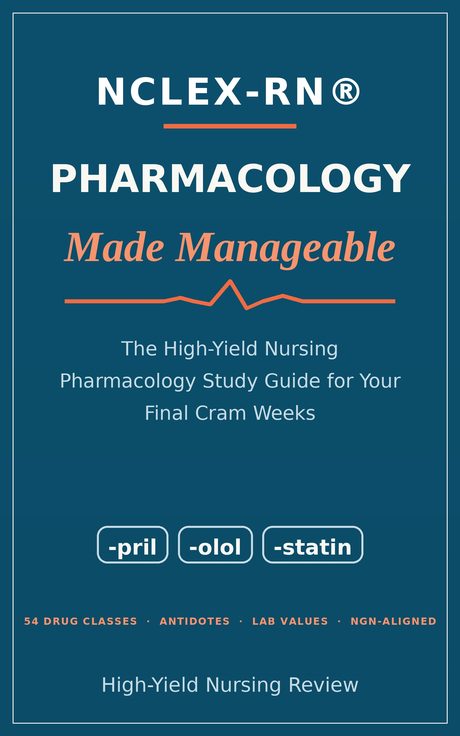
If those three chapters are what you need, the full guide runs the other 51 the same way, with the decoder box leading each one, plus the back-matter cram tables: antidotes, therapeutic drug levels, must-know lab values, the suffix sheet, and a final-week checklist.
- The class-to-question decoder on every class, with worked NGN-style examples on the highest-yield ones.
- 98-page reader PDF plus an EPUB. One price, both formats, for any e-reader. Instant download.
- The bridge between your Q-bank and the exam. One-time payment, yours forever, no subscription.
Secure checkout by Stripe · 7-day refund policy.
Keep the free sample either way. Download it again if you closed it.