Studied hard, but it was not what showed up?
That is the pharmacology problem no review book fixes. This nursing pharmacology study guide does the one thing the big names skip: for every drug class it shows you the exact ways the NCLEX turns that class into a question, so you recognize the question, not just the drug.
The class to NCLEX-question decoder
Most guides tell you what a drug does. They all do. The reason you can study for weeks and still feel ambushed is that nobody shows you how the exam turns the class into a question. That is the whole point of this guide. Every drug class ends with a decoder box that names the specific angles the NCLEX uses for that class, so you spot the trap before you read the options. It maps straight onto the four shapes almost every medication question takes:
Report Adverse effect to report
The dangerous finding, not the harmless expected one.
Priority First nursing action
Usually assess before you act, then hold and notify if a value is out of range.
Teach Patient teaching
The one classic teaching sentence the correct-answer nurse says.
Lab Value to check
The monitored value and its range: INR, potassium, aPTT, an ANC.
Made to fit the study stack you already trust
You are not looking to abandon your Q-bank or your lecture audio, and you should not. This is the cheap bridge that sits between them: the per-class detail your strategy lectures skip, in the test-angle form a Q-bank rationale never spells out.
Less than one month of a premium Q-bank subscription. One-time payment. Yours forever.
The whole method on one page
You do not have time to learn everything about every drug, and the NCLEX does not ask you to. It asks a narrow, predictable set of things. Every drug class comes down to the same five questions, and nothing else, because these five are what the exam rewards.
One line. Not the biochemistry lecture, just the single idea that explains the side effects and the nursing care.
The two or three the NCLEX actually asks about, including the one you must report and the lab or vital sign you must check.
The one sentence the "correct answer" nurse says to the patient.
A mnemonic or image so the class sticks during the cram window.
The specific question angles used for that class, so you spot the trap before you read the options.
Read a class, cover the page, and say the five parts out loud. If you can, you own it. That is the entire system, and it is how this guide and the book are built.
See the decoder work before you spend a cent
This is the difference between reading about a drug and predicting its question. The guide puts a worked example like this on the highest-yield classes, so you practice recognizing the trap instead of just re-reading facts.
A client with heart failure is due for digoxin. Before giving it, the nurse finds an apical pulse of 54, a potassium of 3.2 mEq/L, and a digoxin level of 1.6 ng/mL (a normal level). What is the priority action?
- A. Give the dose as ordered.
- B. Hold the dose and notify the provider.
- C. Give the dose, then recheck the pulse in one hour.
- D. Give a dose of potassium, then the digoxin.
Answer: B. The decoder tells you digoxin is a priority-action class with two hold signals. Both are here at once: an apical pulse under 60, and a low potassium that makes the heart more sensitive to digoxin even though the level itself reads normal. You hold and notify. Recognize the setup and this question is easy. Miss it and the normal level talks you into giving a dangerous dose.
Read the full breakdown of the four question angles and Next Gen NCLEX cases →
Ten safety rules worth 10 memorized drug facts
Memorize these once and you can reason your way to a safe answer even for a drug you do not recognize. They are the backbone of every "priority action" question.
- Airway, breathing, circulation, then safety. A drug that drops the respiratory rate (opioids, benzodiazepines) or the blood pressure and heart rate outranks almost everything. Respiratory rate under 12 or apical pulse under 60 means hold and reassess for most CNS depressants and cardiac drugs.
- Assess before you act. The classic correct first action is to check: apical pulse before digoxin and beta-blockers, potassium before digoxin and diuretics, respiratory rate before opioids, INR before warfarin.
- Hold and notify when a value is out of range. Do not "just give it," and do not change the dose on your own.
- Never stop these abruptly: beta-blockers, clonidine, corticosteroids, antiepileptics, antidepressants, and benzodiazepines. Abrupt stopping causes rebound hypertension, seizures, adrenal crisis, or withdrawal.
- Orthostatic hypotension is a class effect of most blood-pressure, nitrate, and CNS drugs. Teach the patient to change positions slowly.
- Bleeding is the adverse effect for every anticoagulant and antiplatelet. Teach soft toothbrush, electric razor, no NSAIDs, and report black or tarry stools.
- Hypoglycemia is the emergency for every glucose-lowering drug. Shakiness, sweating, confusion. Treat with 15 grams of fast carbs (the rule of 15).
- Narrow-therapeutic-index drugs get level checks: digoxin, lithium, phenytoin, theophylline, vancomycin, aminoglycosides, warfarin (INR), heparin (aPTT). If the stem gives you a level, that is the answer's target.
- Grapefruit juice raises the levels of many drugs (statins, some calcium channel blockers). A frequent "avoid" teaching point.
- The rights of medication administration (right patient, drug, dose, route, time) sit under every safe-administration item.
The high-yield drug classes to know
The book covers 54 drug classes across nine body systems. If your exam is close, these carry the most points per minute. Each links to a full class breakdown or its quick-reference table.
| Class | The one thing that makes it high-yield | NCLEX asks |
|---|---|---|
| Insulin | Hypoglycemia at the peak; know each type's onset and peak. | Priority |
| Anticoagulants heparin, warfarin, DOACs | Bleeding; the lab pairing (aPTT for heparin, INR for warfarin) and the matching antidote. | Lab |
| Digoxin | Narrow range; hypokalemia worsens toxicity; hold if apical pulse under 60. | Report |
| Opioids | Respiratory depression; reverse with naloxone. | Priority |
| Beta-blockers -olol | Bradycardia and hypotension; they mask hypoglycemia in diabetics. | Teach |
| ACE inhibitors -pril | Dry cough, angioedema (airway emergency), high potassium. | Report |
| Diuretics | What each one does to potassium is the whole game. | Lab |
| Statins -statin | Muscle pain and dark urine signal rhabdomyolysis. | Report |
The suffix shortcut
Most drug names carry their class in the ending. Once you see the pattern, you can place a drug you have never met and predict its side effects and nursing care.
-pril
ACE inhibitors (lisinopril). Cough, angioedema, high potassium.
-olol
Beta-blockers (metoprolol). Slow the heart; hold if pulse under 60.
-statin
Cholesterol drugs (atorvastatin). Watch for muscle pain.
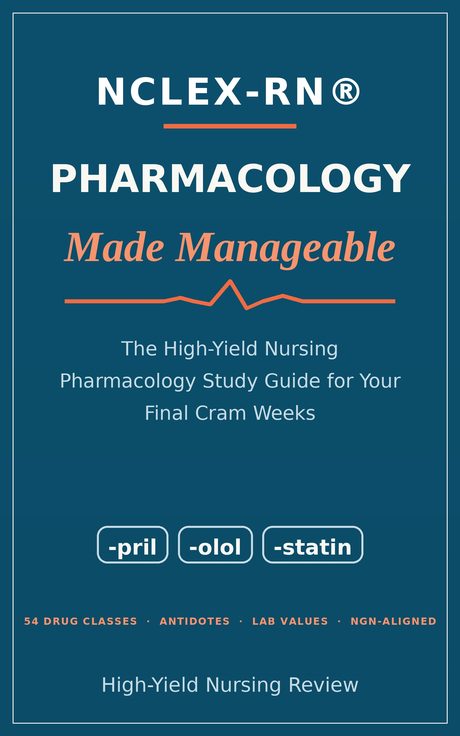
NCLEX-RN® Pharmacology Made Manageable
The class to NCLEX-question decoder for all 54 high-yield drug classes.
Not another tome to get through before your exam. It is the cheap add-on to the study stack you already trust: for each of the 54 high-yield classes, the mechanism that matters, the side effects to report, the one teaching line, a memory hook, and the decoder box that predicts how the NCLEX will ask it.
- Predict the question, do not just memorize the drug. Every class ends with the exact ways the NCLEX asks it, plus worked NGN-style examples on the top classes.
- Everything the big review books bury in over a thousand pages, in about five lines per class. Only the high-yield, test-relevant facts.
- The bridge between your Q-bank and the exam. Less than one month of a premium Q-bank. One-time payment, yours forever, no subscription.
- Two formats, plus the back-matter cram tables. A 98-page screen-reader PDF and an EPUB for any e-reader, with the antidote, drug-level, lab-value, and suffix tables. Delivered instantly.
Secure checkout by Stripe · your purchase is backed by a 7-day money-back guarantee. After payment you land on a private download page and get every file right away.
What you get
REFUND
Buy it, use it, and if it is not what you needed, email felix@foundagent.net within 7 days for a full refund. The free sample is there so you can check the quality first, and the guarantee covers the rest.
What nurses are saying
Be one of the first to review this guide, and get it free
We are a new, independent study-guide publisher, so this page is honest about it: there are no reviews here yet. Rather than buy fake ones, we would rather earn real ones. If you are prepping for the NCLEX now, we will send you the full guide free in exchange for your honest review, whether you loved it or not.
No catch and no obligation. A critical review is just as welcome as a glowing one, and we always disclose that founding reviewers received a free copy.
Already studying with the guide? Leave an honest review. Every review here is real and posted only with the reviewer's permission.
Questions before you buy
Is it current and NGN-aligned?
Yes. The content is framed to the NCLEX-RN test plan effective April 2026, including Next Generation NCLEX (NGN) clinical-judgment item framing. Each chapter carries an NGN cue that flags the exact finding an unfolding case study is likely to bury in the chart. Every clinical fact was cross-checked against standard nursing pharmacology references before release.
What format is it, and will it work on my device?
You get two files: a clean, reflowed PDF made for screens (phone, tablet, laptop) and an EPUB for Kindle, Apple Books, Google Play Books, or any e-reader app. Both are included in the one price. No app or account is required to open them.
How do I get the guide after I pay?
Checkout is handled by Stripe. The moment your payment clears, you land on a private download page with both files ready to save. You also get an email with the same download links as a backup, plus Stripe's own receipt. There is no waiting and no human in the loop.
Can I see the quality before I buy?
Yes, and you should. The free sample is a real, unedited slice of the book: the complete table of contents, the five-part study method, and two full drug-class chapters (Digoxin and Insulins), formatted exactly as in the guide. No email required to read or download it.
What if it is not for me? (Refunds)
Every purchase is backed by a 7-day money-back guarantee. If the guide is not what you needed, email felix@foundagent.net within 7 days of purchase for a full refund. See the refund policy for details.
Get the high-yield cheat sheet in your inbox
Drop your email and we will send you the free High-Yield NCLEX Pharmacology Cheat Sheet as a printable PDF right away: antidotes, high-alert drugs, and the lab-value cutoffs the exam leans on. We email rarely (a note when the Kindle and paperback editions go live), and you can unsubscribe in one click. Founding reviewers welcome: after you join, just reply to the welcome email and we will send you the full guide free to review honestly.
Common questions
Do I have to memorize every drug?
No. Almost every drug on the NCLEX belongs to a class that shares one mechanism, a signature set of side effects, and a teaching point. Learn the class, recognize the suffix, and you can reason through a drug you have never seen.
How much of the exam is pharmacology?
Pharmacology sits in the Pharmacological and Parenteral Therapies section of the test plan and makes up roughly 13 to 19 percent of your questions, one of the largest single slices of the exam. See the full breakdown of how much pharmacology is on the NCLEX →
How should I study pharmacology for the NCLEX?
Study by drug class instead of by drug, learn the suffixes, and drill the patterns the exam reuses. The step-by-step plan for studying NCLEX pharmacology walks through it with free flashcards and practice questions.
Where should I start if my test is next week?
Read the ten safety rules above, then the antidote and lab-value tables. Prioritize insulin, anticoagulants, digoxin, and opioids. Those carry the most points for the least time.