High-yield NCLEX drug classes
These seven classes carry a large share of the pharmacology points on the NCLEX-RN, and they are where most candidates feel the blurry mess. Each one is laid out the same way: the mechanism that matters, the side effects and monitoring, the classic teaching sentence, a memory hook, and how the exam tests it. The full book covers all 54 classes this way; these are the ones to know cold.
Digoxin
Key drug: digoxin (Lanoxin). This class is essentially one drug, so know it cold.
Makes the heart beat stronger but slower. It raises the force of contraction and lowers the heart rate while slowing conduction through the AV node. Used in heart failure and to control the rate in atrial fibrillation.
Narrow therapeutic range of 0.8 to 2 ng/mL; above 2 is toxic. Early toxicity looks like anorexia, nausea, vomiting, and visual changes such as blurred vision or yellow-green halos around lights, along with fatigue, confusion, and bradycardia. Low potassium (under 3.5) worsens toxicity even when the digoxin level reads normal, which matters because diuretics are often given alongside it. Antidote: digoxin immune Fab (DigiFab).
"Count your pulse for one full minute before each dose. If it is below 60, hold the dose and call your provider. Report nausea, loss of appetite, or seeing yellow or blurry halos around lights." Do not take a double dose to make up a missed one.
SICK DIG: See yellow, Irregular or slow pulse, Confusion, K low. Check the apical pulse for a full 60 seconds before giving DIGoxin.
Report yellow or green visual halos, anorexia, nausea, and vomiting as toxicity.
Priority take the apical pulse for one full minute; hold and notify if under 60 in an adult. Check the latest potassium and digoxin level.
Lab digoxin level 0.8 to 2 ng/mL, and potassium 3.5 to 5.0. Low potassium is the trap.
A chart showing an apical pulse of 52, a potassium of 3.1, or a patient who mentions "seeing yellow." Recognize digoxin toxicity, hold the dose, notify, and anticipate DigiFab.
Beta-blockers
Key drugs (suffix -olol): metoprolol, atenolol, carvedilol, propranolol, labetalol. Cardioselective agents (metoprolol, atenolol) act mainly on the heart; nonselective agents (propranolol) also hit the lungs.
Block beta-1 receptors in the heart, which lowers the heart rate, the force of contraction, and the blood pressure. Nonselective agents also block beta-2 in the lungs, which risks bronchoconstriction.
Bradycardia and hypotension (hold for a heart rate under 60 or symptomatic low blood pressure). They mask the early signs of hypoglycemia such as a racing heart and tremor in people with diabetes, though sweating is preserved. Nonselective agents can trigger bronchospasm, so use caution in asthma and COPD. Do not stop abruptly, because rebound hypertension, angina, or a heart attack can follow; taper over one to two weeks.
"Check your pulse daily and hold the dose if it is below 60. Rise slowly. Do not stop this medication suddenly. If you have diabetes, check your blood sugar more often, because this drug can hide the early warning signs of a low."
"-olol = LOL, the heart slows down and chills out." Nonselective blockers reach the lungs too, so propranolol can be a problem in asthma.
Report a heart rate under 60, new wheezing or shortness of breath, and signs of worsening heart failure such as weight gain or edema.
Priority assess the apical pulse and blood pressure before giving; hold and notify if the heart rate is under 60 or the pressure is low.
Teach do not stop abruptly, rise slowly, and know that hypoglycemia is masked in diabetics.
An apical pulse of 48 on the chart, or an asthmatic newly prescribed a nonselective beta-blocker.
ACE inhibitors
Key drugs (suffix -pril): lisinopril, enalapril, captopril, ramipril.
Block the enzyme that converts angiotensin I into angiotensin II. Less angiotensin II means vasodilation and less aldosterone, so blood pressure falls and there is less strain on the heart and kidneys. Protective in heart failure and diabetic kidney disease.
Dry, hacking cough from bradykinin: common and harmless, but a reason to switch to an ARB. Angioedema (swelling of the face, lips, tongue, or throat) is an airway emergency: stop the drug and notify at once. High potassium, so avoid salt substitutes. First-dose hypotension is possible; monitor kidney function. Contraindicated in pregnancy.
"A persistent dry cough can happen; tell your provider, who may switch your medicine. Report any swelling of the face, lips, or tongue right away. Avoid salt substitutes, since they contain potassium. Rise slowly. Do not use if you might be pregnant."
ACE = Angioedema, Cough, Elevated potassium. Captopril makes you cough.
Report facial or tongue swelling as the priority; a persistent dry cough means call the provider.
Priority for angioedema, stop the drug, protect the airway, and notify.
Lab potassium and kidney function; blood pressure for first-dose hypotension.
New facial or tongue swelling with difficulty breathing, or a potassium of 5.8 on lisinopril.
Insulin
Know the peaks: the peak is when hypoglycemia is most likely, and that is exactly what the exam asks you to reason about.
| Type | Examples | Onset | Peak | Note |
|---|---|---|---|---|
| Rapid-acting | lispro, aspart, glulisine | ~15 min | ~1 to 2 h | Give with the meal |
| Short (Regular) | regular | 30 to 60 min | ~2 to 3 h | Only insulin given IV |
| Intermediate | NPH | 1 to 2 h | ~4 to 12 h | Cloudy suspension |
| Long-acting | glargine, detemir | 1 to 2 h | no real peak | Do not mix |
Moves glucose out of the blood and into cells. It also drives potassium into cells, which is why IV insulin with dextrose is used to treat high potassium.
Hypoglycemia is the emergency, most likely at the insulin's peak: shakiness, sweating, hunger, confusion, progressing to seizures. Treat a conscious patient with the rule of 15: give 15 grams of fast carbohydrate (4 oz juice or glucose tablets), recheck in 15 minutes, and repeat if still low. Insulin can also lower potassium. Rotate sites to avoid lipohypertrophy. This is a high-alert drug, so unit and look-alike name errors cause serious harm.
"Rotate your injection sites within one body area. Store the pen you are using at room temperature and keep spares in the fridge; never freeze insulin. Roll cloudy NPH gently to mix it rather than shaking. Always carry a fast sugar source, and do not skip meals after a dose." Mixing NPH with Regular: draw up the clear before the cloudy (Regular before NPH).
"When it PEAKS, watch for the LOW." "Clear before cloudy." Rapid insulin goes in with the plate.
Report and recognize hypoglycemia; know the rule of 15.
Priority if hypoglycemic and conscious, give 15 grams of fast carbs and recheck; anticipate the peak time.
Lab blood glucose, and potassium in specific scenarios.
A patient given rapid insulin whose breakfast tray is delayed. The move is to hold or get food, not to give more insulin.
Heparin
Key drugs: unfractionated heparin (IV or subcutaneous); low-molecular-weight heparin such as enoxaparin (Lovenox).
Activates antithrombin, which then inactivates thrombin and factor Xa, so new clots cannot form and existing ones cannot grow. It works fast, so it is the bridge while slower warfarin takes effect.
Bleeding is the main risk. Heparin-induced thrombocytopenia (HIT) is a drop in platelets that paradoxically causes clots, so monitor the platelet count. Unfractionated heparin is monitored with the aPTT (roughly 1.5 to 2.5 times the control). LMWH usually needs no routine monitoring. Antidote: protamine sulfate.
For subcutaneous enoxaparin: "Inject into the fatty tissue of your abdomen, at least two inches from the navel, and rotate sites. Do not expel the air bubble in the prefilled syringe, and do not rub the site afterward, since both increase bruising."
"Heparin, aPTT, Protamine" all carry a P. Contrast with warfarin, INR, vitamin K.
Report any bleeding and a falling platelet count (HIT).
Priority monitor aPTT and platelets; for bleeding, anticipate protamine; give subcutaneous doses correctly (do not aspirate, do not rub).
Lab aPTT, platelet count, and hemoglobin.
A platelet count dropping from 250,000 to 90,000 several days into heparin. Suspect HIT, stop the heparin, and notify.
Warfarin
Key drug: warfarin (Coumadin). A high-alert medication with a boxed warning for bleeding.
Blocks the vitamin-K-dependent clotting factors (II, VII, IX, X) made in the liver. It works slowly over two to five days, so patients are often bridged with heparin until it reaches target.
Bleeding is the main risk. Monitor the PT/INR: the therapeutic INR is 2 to 3 for most indications (2.5 to 3.5 for a mechanical heart valve). Above range means a high bleeding risk. Antidote: vitamin K (phytonadione). Many food and drug interactions, and it is contraindicated in pregnancy.
"Keep your intake of vitamin-K foods such as spinach, kale, and broccoli consistent: you do not have to avoid them, just do not suddenly eat a lot more or less. Use a soft toothbrush and an electric razor, avoid aspirin and NSAIDs, and report black or tarry stools, pink urine, or unusual bruising. Keep every INR appointment."
"Warfarin, Watch the INR, Vitamin K reverses." The clotting factors are 2, 7, 9, 10 (the "1972" set).
Report any bleeding (tarry stools, blood in the urine, bruising) and an INR above range.
Priority review the INR before dosing; hold and notify for a high INR; anticipate vitamin K.
Lab INR (2 to 3 typical; 2.5 to 3.5 for a mechanical valve).
An INR of 5.5 with gum bleeding. Hold the warfarin, notify, and anticipate vitamin K.
Opioids
Key drugs: morphine, hydromorphone (Dilaudid), fentanyl, oxycodone, hydrocodone, codeine. Reversal: naloxone (Narcan).
Bind opioid (mu) receptors in the central nervous system to produce pain relief, along with sedation and slowed breathing.
Respiratory depression is the priority adverse effect: assess the respiratory rate and sedation before and after dosing, and hold and reassess if the rate is under 12. Constipation is near-universal and does not improve over time, so start a stool softener from the beginning. Also sedation, pinpoint pupils, hypotension, urinary retention, and dependence. Antidote: naloxone, but it is short-acting, so watch for re-sedation and repeat as needed.
"Prevent constipation with fluids, fiber, and a stool softener from the start. Do not drink alcohol or drive while taking it. Take it exactly as prescribed, since these drugs carry a real risk of dependence. Store it safely and dispose of leftover pills properly."
The overdose triad: pinpoint pupils, depressed breathing, coma. "Respiratory rate under 12, hold and reassess." Naloxone (Narcan) negates the opioid.
Report a respiratory rate under 12 and excessive sedation (the priority); persistent constipation.
Priority assess the respiratory rate and sedation; stimulate, give naloxone, and monitor for re-sedation.
Lab respiratory rate, sedation level, oxygen saturation, and pain score.
A post-op patient with a respiratory rate of 8 and heavy sedation after morphine. Hold the opioid, stimulate, give oxygen and naloxone, then monitor for re-sedation.
Nursing considerations, drug by drug
Each drug and high-yield topic below has its own free page: the exact NCLEX nursing considerations, how the exam turns it into a question, an NGN cue, and the teaching that matters. No signup.
Cardiovascular
Digoxin Metoprolol Carvedilol Lisinopril Calcium channel blockers Diltiazem Amiodarone Nitroglycerin Furosemide SpironolactoneRespiratory
AlbuterolKeep going
Two things pull the rest of pharmacology together fast: the suffix system, which lets you place a drug you have never seen, and the cram tables of antidotes and lab values.
All 54 classes, same system
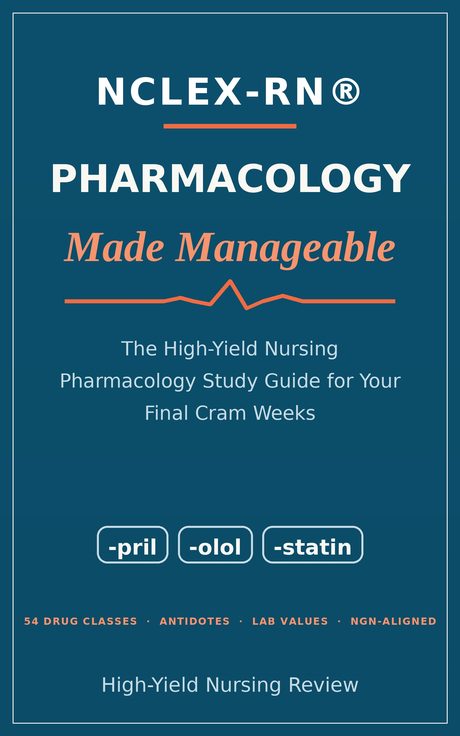
You just read seven. The full guide runs the other 47 the same way, across cardiovascular, blood, endocrine, respiratory, anti-infective, neuro, GI, and parenteral therapies, and closes with the cram tables. Kindle and paperback.
98-page PDF + EPUB · instant download · 7-day money-back guarantee · free sample
Get the high-yield cheat sheet by email
Drop your email and we will send you the free High-Yield NCLEX Pharmacology Cheat Sheet as a printable PDF: antidotes, high-alert drugs, and the lab-value cutoffs the exam leans on. We email rarely, and you can unsubscribe in one click.