The pharmacology suffix cheat sheet
Most drug names carry their class in the ending. A drug ending in -pril is an ACE inhibitor. One ending in -olol is a beta-blocker. Once you know the pattern, you can place a drug you have never met, and from the class you can predict its mechanism, its main side effect, and the nursing care. On the exam, that turns an unfamiliar drug name from a dead end into an answerable question.
Do not memorize this as a list. For each suffix, tie it to the one thing the NCLEX asks about that class. "-olol slows the heart, so hold for a pulse under 60." "-statin, watch the muscles." "-pril, cough and angioedema." The suffix is the hook; the nursing point is what earns the answer.
The full suffix table
| Suffix or stem | Class | Example |
|---|---|---|
| -pril | ACE inhibitors | lisinopril |
| -sartan | ARBs | losartan |
| -olol | Beta-blockers | metoprolol |
| -dipine | Calcium channel blockers (dihydropyridine) | amlodipine |
| -osin | Alpha-1 blockers | prazosin, tamsulosin |
| -statin | Statins | atorvastatin |
| -xaban | Factor Xa inhibitors (DOACs) | apixaban |
| -parin | Low-molecular-weight heparins | enoxaparin |
| -ase | Thrombolytics | alteplase |
| -pam / -lam / -azepam | Benzodiazepines | lorazepam, alprazolam |
| -prazole | Proton pump inhibitors | omeprazole |
| -tidine | H2 blockers | famotidine |
| -cillin | Penicillins | amoxicillin |
| cef- / ceph- | Cephalosporins | cephalexin |
| -thromycin | Macrolides | azithromycin |
| -cycline | Tetracyclines | doxycycline |
| -floxacin | Fluoroquinolones | ciprofloxacin |
| -sone / -olone | Corticosteroids | prednisone |
| -tide | GLP-1 agonists | semaglutide |
| -flozin | SGLT2 inhibitors | empagliflozin |
| -gliptin | DPP-4 inhibitors | sitagliptin |
| -triptyline / -ipramine | Tricyclic antidepressants | amitriptyline |
| -vir | Antivirals | acyclovir |
A few stems overlap. "-mycin" shows up in aminoglycosides, in vancomycin, and in macrolides; "-done" appears in some opioids and some antipsychotics. When a stem is ambiguous, the surrounding stem tells you the class, so lean on context.
Putting it to work: three unknown drugs
The point of the table is not recognition for its own sake. It is that a suffix hands you the nursing care. Here is the reasoning the exam is testing.
enalapril
Ends in -pril, so ACE inhibitor. Expect a dry cough, watch for angioedema, monitor potassium, and hold nothing about the pregnancy warning.
rivaroxaban
Ends in -xaban, so a factor Xa inhibitor. Bleeding is the risk; the reversal is andexanet alfa; take it with food.
pantoprazole
Ends in -prazole, so a proton pump inhibitor. Take it before breakfast; long-term use lowers magnesium and B12.
You have never been taught these three specifically, and it does not matter. The ending places each one, and the class carries the answer. That is the whole trick, and it scales to almost every drug on the exam.
Suffixes are a shortcut, not a law. A handful of important drugs do not follow a clean pattern (digoxin, warfarin, furosemide, insulin), so those you learn by name. And a stem can mislead: duloxetine ends like an SSRI but is an SNRI. Use the suffix to get close, then confirm with what you know about the specific drug.
Related
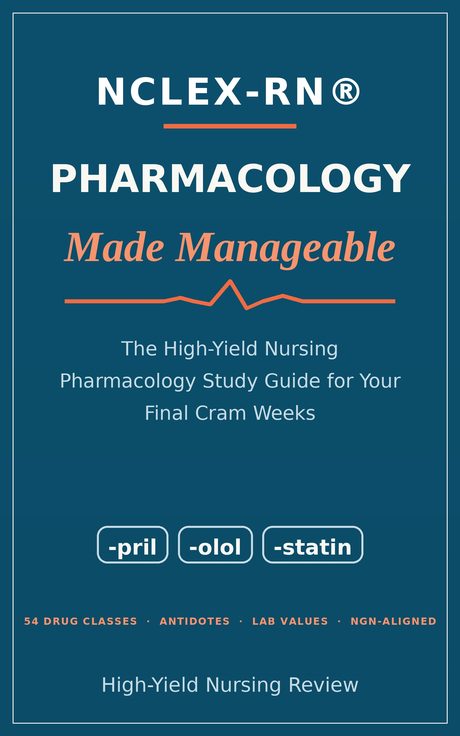
The whole system, not just the endings
The suffix sheet is one page of the book. The rest builds each class around it: mechanism, the side effect to report, the teaching sentence, and how the exam turns it into a question. Kindle and paperback.
98-page PDF + EPUB · instant download · 7-day money-back guarantee · free sample
Get the high-yield cheat sheet by email
Drop your email and we will send you the free High-Yield NCLEX Pharmacology Cheat Sheet as a printable PDF: antidotes, high-alert drugs, and the lab-value cutoffs the exam leans on. We email rarely, and you can unsubscribe in one click.