How to study pharmacology for the NCLEX
Pharmacology feels impossible when you try to study it drug by drug. There are hundreds of medications, and no one remembers all of them. The nurses who do well on medication questions are not the ones who memorized the most drugs. They learned a smaller number of classes and a handful of patterns the exam repeats. This page is the plan: six steps, in order, with the free tools to practice each one.
1. Study classes, not individual drugs
This is the single change that makes pharmacology manageable. Almost every drug belongs to a class whose members share one mechanism, a signature set of side effects, and a teaching point. Learn the class once and you can answer a question about any drug in it, including one you have never seen on test day. Beta-blockers all slow the heart. ACE inhibitors all risk a dry cough and high potassium. Anticoagulants all cause bleeding. You are learning a few dozen stories, not a few hundred flashcards.
Start with the high-yield drug classes: full breakdowns of the classes that carry the most points, each on the same system.
2. Learn the suffixes
Most drug names carry their class in the ending. Once you know that -pril is an ACE inhibitor, -olol is a beta-blocker, and -statin is a cholesterol drug, an unfamiliar name is no longer a dead end. You place it in a class and you already know its main side effect and nursing care. Learning about twenty endings covers a large share of the drugs the exam uses.
See the pharmacology suffix cheat sheet for the endings mapped to their class.
3. Ask the same five questions of every class
Do not read everything about a class. Read for the five things the NCLEX actually rewards, and skip the rest for now:
- Mechanism in one line, just enough to explain the side effects.
- Side effects, the two or three the exam asks about, including the one you must report.
- Teaching, the one sentence the correct-answer nurse says to the patient.
- Memory hook, a mnemonic or image so the class sticks during the cram.
- How it is tested, the specific question angle used for that class.
Read a class, cover the page, and say the five parts out loud. If you can, you own it. That check is the whole study method.
4. Learn the four ways the NCLEX asks a med question
Almost every medication question is one of four shapes. Name the shape first and you know what the answer is for before the options can distract you:
Report The effect to report
The answer is the dangerous effect, not the harmless expected one.
Priority The first action
Usually assess before you act, then hold and notify if a value is out of range.
Teach Patient teaching
Know the one classic teaching sentence for the class.
Lab The value to check
Know the monitored lab and its range: INR for warfarin, potassium for digoxin.
Read the full breakdown of the four angles and Next Gen NCLEX cases →
5. Drill with active recall, not rereading
Rereading your notes feels productive and teaches you almost nothing. What sticks is recall: trying to produce the answer before you see it. Two free ways to do that on this material:
- Nursing pharmacology flashcards: a free, Quizlet-style trainer for the lab values and therapeutic drug levels the exam tests. See the name, recall the range, flip, and grade yourself.
- NCLEX pharmacology practice questions: a free quiz with a full rationale on every answer, written to mirror how the exam presents a medication.
Do a little every day rather than one long session. Spaced, repeated recall is what moves a fact from "I have seen it" to "I know it cold."
6. Cram the high-yield tables last
In the final week, some things are pure memorization and there is no shortcut: the must-know antidotes, the narrow-therapeutic-index drug levels, the lab values you check before giving a drug, and the hold parameters. Put these on one page and review them daily until test day.
How much time do you need?
There is no single number, but the method scales to the time you have. With several weeks, work through the classes a few at a time, drilling recall as you go, and save the cram tables for the last week. With only a few days, skip straight to the highest-yield classes (insulin, anticoagulants, digoxin, opioids) and the cheat-sheet tables, and practice questions to find your gaps. Pharmacology is one of the largest single slices of the exam, so time spent here pays off more than most. See how much of the NCLEX is pharmacology →
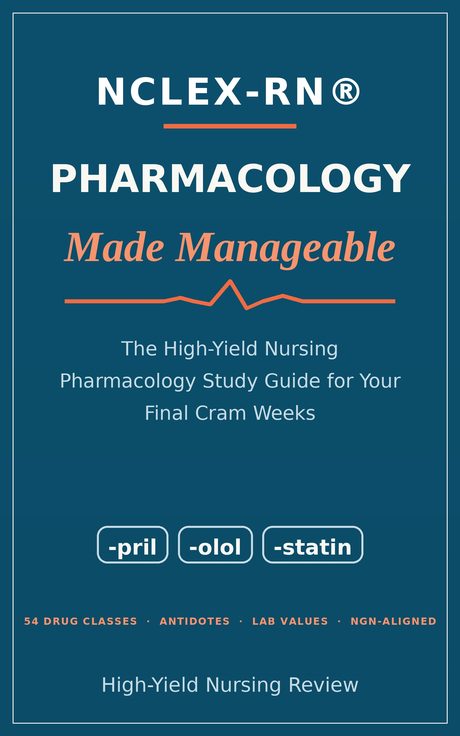
The whole method in one guide
The full guide walks all 54 high-yield drug classes through the same five-part system, then hands you the back-matter cram tables: antidotes, therapeutic drug levels, must-know lab values, the suffix sheet, and a final-week checklist.
98-page PDF + EPUB · instant download · 7-day money-back guarantee · free sample
Get the high-yield cheat sheet by email
Drop your email and we will send you the free High-Yield NCLEX Pharmacology Cheat Sheet as a printable PDF: antidotes, high-alert drugs, and the lab-value cutoffs the exam leans on. We email rarely, and you can unsubscribe in one click.